
Here’s your Guide to Understanding the BIS Certification Process, ISI Marking, CRS, FMCS, Product Testing, Factory Inspection, and Compliance Requirements
Manufacturing compliance in India has become increasingly important for manufacturers, importers, foreign manufacturers, startups and businesses dealing with regulated products.
With the expanding Quality Control Orders (QCOs), products under mandatory certification and increasing regulatory enforcement, understanding the Bureau of Indian Standards (BIS) certification process is no longer optional for many industries.
Whether you are a domestic manufacturer planning to obtain an ISI Mark license, an electronics brand requiring CRS registration, or a foreign manufacturer intending to export regulated products into India under FMCS, understanding the BIS ecosystem is essential.
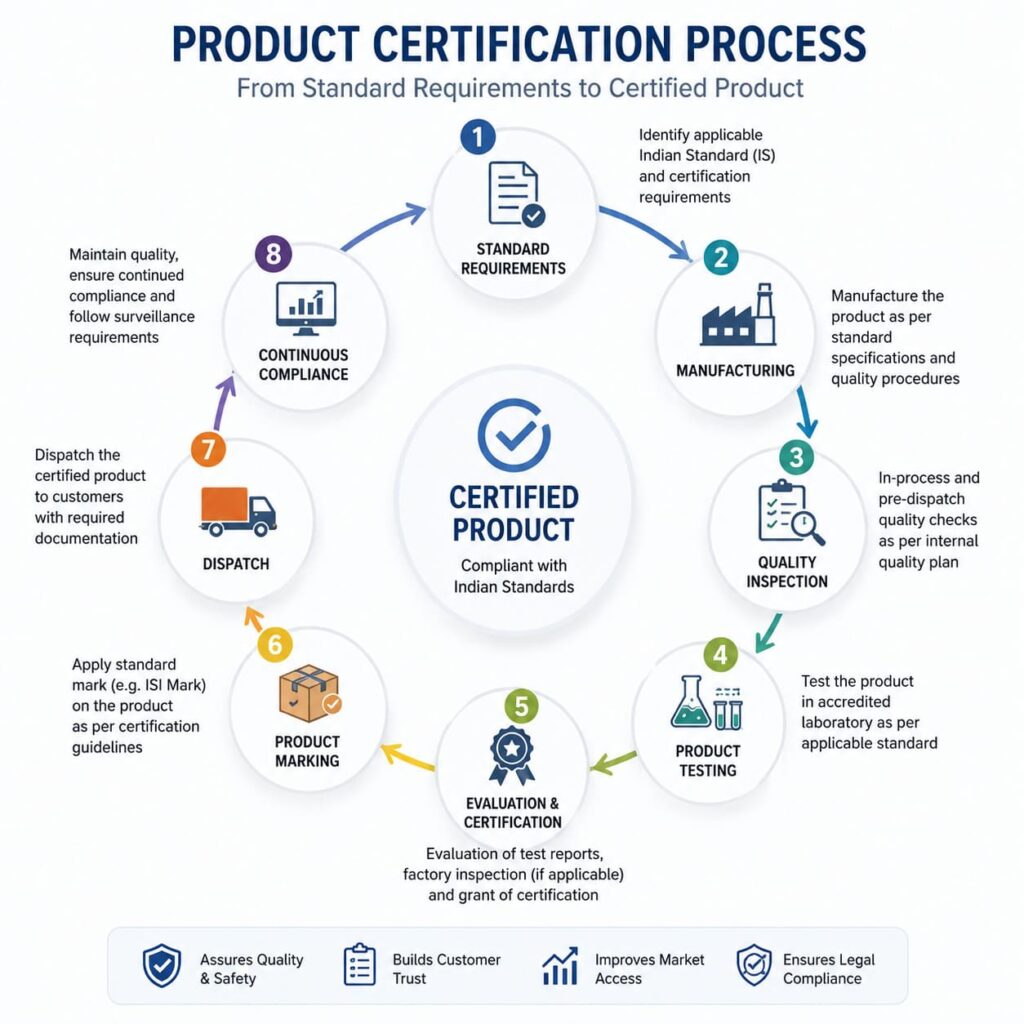
This guide explains the BIS certification process in a structured and practical manner, covering the following topics:
- What BIS certification is all about
- Why it matters
- Types of BIS certification schemes
- Products covered under BIS certification
- ISI, CRS, and FMCS certification systems
- Documentation requirements
- Product testing procedures
- Factory inspection process
- Timelines and fees
- Common reasons for delay or rejection
- Frequently asked questions (FAQs)
The objective of this guide is to simplify manufacturing compliance and help businesses understand how the BIS certification system works in practice.
What Is BIS Certification?
BIS Certification refers to the product certification (also called conformity assessment) system administered by the Bureau of Indian Standards (BIS), the National Standards Body of India.
BIS operates under the Bureau of Indian Standards Act 2016 (Ministry of Consumer Affairs, Food & Public Distribution, Government of India) and is responsible for:
- Development of Indian Standards (IS)
- Conformity assessment (Product certification)
- Hallmarking of Jewellery
- Testing of Products and Laboratory recognition
- Promotion of Standards
- Consumer protection through standardization
In simple terms, BIS certification is a verification that a product conforms to applicable Indian Standards with respect to:
- quality
- safety
- performance
- reliability
- durability
- environmental requirements etc. as specified in the Standard.
Depending on the product category and applicable regulations, BIS certification may either be:
- Voluntary
or - Mandatory
For many regulated products covered under Quality Control Orders (QCOs), BIS certification becomes mandatory for manufacture, import, sale, or distribution in the Indian market.
The certification process generally involves the following steps:
- identification of applicable standards
- submission of application
- product testing
- factory assessment or inspection
- verification of manufacturing infrastructure
- evaluation of quality control systems
- grant of license or registration
The exact process varies depending on the applicable BIS scheme.
Why BIS Certification Matters
BIS certification serves multiple purposes for regulators, consumers, manufacturers, and businesses. We will describe this in detail in the following section.
1. Regulatory Compliance
For products covered under mandatory certification schemes or Quality Control Orders, BIS certification is a legal and regulatory requirement.
Manufacturing or importing regulated products without required BIS approval may result in:
- Product seizure
- Penalties
- Customs clearance issues
- Prosecution under BIS Act 2016
- Market restrictions
- Restrictions including cancellation of business operations
Compliance is, therefore, essential for lawful market access.
2. Product Safety and Quality Assurance
Indian Standards are designed to ensure products meet specified requirements related to:
- Electrical safety
- Mechanical strength
- Chemical composition
- Performance
- Durability
- Reliability
- Consumer safety
Certification helps maintain product consistency and reduces risks associated with substandard or unsafe products. This is of prime importance.
3. Consumer Confidence
Products carrying BIS certification marks such as:
- ISI Mark
- CRS Registration
often enjoy greater consumer trust because they indicate conformity to Indian Standards. Consumers increasingly recognize BIS certification as a quality and safety benchmark.
4. Market Access
Many sectors in India now require mandatory compliance. The Government, from time to time, issues QCOs notifying mandatory compliance requirement for various products.
Without BIS certification, businesses may face difficulty in:
- Selling products in India
- Participating in government tenders
- Entering organized retail markets
- Exporting regulated goods into India
Certification enables legal and commercial market access.
5. Competitive Advantage
Compliance can strengthen business credibility. It is also the first step towards adhering to the required norms of modern trade and commerce.
Manufacturers with BIS-certified products may gain advantages in:
- Institutional procurement
- Distributor confidence
- Retailer acceptance
- Customer perception
- Export competitiveness
6. Standardization and Manufacturing Discipline
The certification process often improves:
- Process control
- Documentation systems
- Quality assurance procedures
- Traceability
- Testing infrastructure
- Manufacturing consistency
Many businesses experience operational improvements after implementing certification requirements.
Products Covered Under BIS
A large number of products in India are covered under BIS certification schemes.
Coverage continues to expand through Quality Control Orders issued by various ministries and departments.
Products may fall under:
- ISI Certification Scheme for Domestic manufacturers
- CRS Registration Scheme for Electronic Consumer product manufacturers
- FMCS for Foreign manufacturers
Examples of products commonly covered under BIS certification include:
Electrical Products
- Switches
- Cables
- Various Domestic Appliances
- LED lighting products
- Transformers
- Batteries
- Plugs and sockets and more
Electronics & IT Products (Covered under CRS)
- Laptops & PC Monitors
- Mobile phones
- Televisions, Set Top Boxes
- Power adapters
- Smart watches
- Printers, Scanners
- Routers
- LEDs
Steel and Metal Products
- Steel bars
- Stainless steel products
- Pipes and tubes
- Metal fasteners
- Structural steel
Construction Materials
- Cement
- Plywood
- Gypsum boards
- Pressure pipes
- Doors and windows
Other Consumer Products
- Toys
- Footwear
- Helmets for Two-Wheelers
- Pressure cookers
- Kitchen appliances
Chemicals and Industrial Materials
- Acids
- Fertilizers
- Petrochemical products
- Industrial gases
- Paints and coatings
Automotive and Industrial Components
- Tyres
- Valves
- Bearings
- Automotive parts like windshields
- Industrial machinery components
The applicable certification requirement depends on:
- Product category
- Applicable Indian Standard
- Notified Quality Control Orders
- Manufacturing location
- Intended market use
Manufacturers should always verify whether a product is covered under mandatory BIS requirements before production or import. The same can be checked through the various QCOs issued and from BIS Website.
Types of BIS Certification
BIS operates multiple certification schemes depending on the nature of products and manufacturing locations. In order to manufacture, sale and distribute your products in the Indian market, it is often required to obtain BIS Certification marks License.
The three most important schemes are:
- ISI Certification Scheme
- Compulsory Registration Scheme (CRS)
- Foreign Manufacturers Certification Scheme (FMCS)
ISI Certification
The ISI Certification Scheme is one of the oldest and most widely recognized product certification systems in India. It is applicable for most consumer products in India.
Products certified under this scheme are allowed to use the ISI Standard Mark that indicates conformity to applicable Indian Standards.
Products Typically Covered Under ISI
Some of the common products covered under the ISI Mark include:
- Cement & Concrete products
- Electrical appliances (Safety)
- Switches & Sockets
- Pressure cookers
- Helmets
- Various Steel products
- LPG Cylinders, Valves, Regulators & Stoves
- Various household appliances like geysers, ceiling fans, mixer-grinders etc.
- Food products such as Infant baby formula and biscuits.
Key Features of ISI Certification
The key features of ISI Mark Certification involves the following components.
- Factory inspection is generally required
- Product testing is mandatory
- Manufacturing infrastructure is assessed
- Quality control systems are evaluated
- Marking fee as applicable
- Surveillance inspections and market sample drawl may be conducted
Grant of BIS Certification Marks License.
Upon successful completion of evaluation and compliance verification, BIS grants a license permitting use of the Standard Mark.
The manufacturer must continue maintaining compliance after grant of license.
CRS (Compulsory Registration Scheme)
The Compulsory Registration Scheme (CRS) of BIS primarily covers electronics and IT products.
The scheme is implemented by BIS in coordination with the Ministry of Electronics and Information Technology (MeitY).
The products covered under CRS are already mentioned above. It is different from the ISI Scheme.
Key Features of CRS
- Registration-based scheme
- Product testing through BIS-recognized laboratories
- No regular factory inspection during initial registration in many cases
- Product-specific registration
- Manufacturer-based registration
CRS Labeling
Registered products are required to bear:
- CRS registration number
- BIS Standard Mark
as per applicable marking guidelines.
Importance of CRS
CRS compliance is critical for electronics brands, importers, OEM manufacturers, and technology companies operating in India.
FMCS (Foreign Manufacturers Certification Scheme)
The Foreign Manufacturers Certification Scheme (FMCS) applies to foreign manufacturers intending to export regulated products to India.
Under FMCS, overseas manufacturers may obtain BIS certification for products covered under applicable Indian Standards.
Key Features of FMCS
- Foreign factory inspection is generally required
- Product testing is mandatory
- Appointment of Authorized Indian Representative (AIR) is required
- Manufacturing capability assessment is conducted
- Quality control infrastructure is evaluated
Products Commonly Covered Under FMCS
The FMCS scheme is similar to ISI scheme but is meant for manufacturers situated outside India. So the products covered under this scheme are those that are covered under ISI scheme.
Here are some important features of FMCS which are not required for domestic manufacturers under the ISI scheme. For instance, Authorized Indian Representative (AIR) has a significant role in product compliance under BIS.
Importance of AIR
Foreign manufacturers are typically required to appoint an Authorized Indian Representative responsible for coordination with BIS.
The AIR plays an important role in:
- Bridging communication between manufacturer (licensee) and BIS
- Compliance coordination
- Document submission
- Regulatory liaison
Who Needs BIS Certification?
So we’ve come this far. But who actually need BIS Certification?
The requirement for BIS certification depends on:
- Product category
- Applicable regulations
- Manufacturing location
- Intended market
- Quality Control Orders
Entities that may require BIS certification include:
Domestic Manufacturers
Indian manufacturers producing regulated products may require:
- ISI certification
- CRS registration
before manufacturing or selling their products.
Foreign Manufacturers
Foreign manufacturers exporting products into India may require:
- FMCS certification
- CRS registration
depending on the product category.
Importers
Importers dealing with regulated products must ensure imported goods comply with applicable BIS requirements.
Non-compliant imports may face:
- customs detention
- rejection
- seizure
- regulatory action
Brand Owners and OEM Businesses
Businesses selling products under private labels or brand names should carefully evaluate:
- Manufacturer responsibility
- Registration ownership
- Labeling compliance
- Certification obligations
E-Commerce Sellers
Online marketplaces increasingly require compliance documentation for regulated products.
Non-compliant products may be removed from online platforms.
Step-by-Step BIS Certification Process
The exact process varies depending on the scheme, but the overall certification workflow generally involves the following stages.
Step 1: Identify Applicable Indian Standard
The first step is identifying:
- Applicable Indian Standard (IS)
- Certification scheme
- Product category
- QCO applicability
This stage is critical because incorrect identification may lead to:
- Application rejection
- Testing failure
- Delays in processing of application
- Regulatory non-compliance
Step 2: Evaluate Product Scope and Applicability for Certification
Manufacturers should verify:
- Whether the product falls under mandatory certification
- Applicable variants/models
- Product grouping rules
- Test requirements
- Marking obligations
Technical evaluation during this stage is important.
Step 3: Prepare Documentation
The applicant prepares:
- Manufacturing documents – lists of machinery & equipments
- Quality control records
- Product specifications
- Test-related information such as in-house test reports
- Factory details such as location and layout
- Legal documents such as registration of company
Documentation quality significantly affects processing timelines. Queries may be raised at application stage which can hamper the processing of application for BIS License.
Step 4: Product Testing
Samples are tested as per applicable Indian Standards.
Testing may be conducted at:
- BIS laboratories
or - BIS-recognized external laboratories
Testing verifies compliance with:
- Safety requirements
- Performance requirements
- Dimensional requirements
- Chemical requirements
- Electrical requirements
depending on the standard.
Step 5: Application Submission
The applicant submits:
- An application form in the prescribed format (called Form-V)
- Supporting documents
- Test reports where applicable
- Requisite fees
through applicable BIS procedures or online systems. Currently, online portal is available only for domestic manufacturers.
Step 6: Factory Inspection / Audit
For schemes involving inspection( ISI, FMCS), BIS officer deputed for audit assess:
- Manufacturing capability
- Process controls adequacy
- Testing infrastructure
- Quality assurance systems
- Production records
- Calibration systems and arrangement
- Competence of Quality control personnel
This stage is extremely important.
Step 7: Evaluation of Compliance
BIS evaluates:
- Submitted documents
- Technical observations during factory inspection
- Test reports of Raw materials and products
- Manufacturing systems and process flow vîs-a-vîs quality control
- Compliance capability overal with respect to the requirements of the relevant Indian Standard
Additional clarifications may be requested. The same is required to be complied with for further processing of applications.
Step 8: Grant of License or Registration
If requirements are satisfactorily fulfilled, BIS grants:
- BIS Certification Marks License
or - Registration
The manufacturer may then use the applicable BIS mark subject to compliance conditions.
Step 9: Post-Certification Compliance
Compliance responsibilities continue after certification.
Manufacturers may need to:
- maintain records
- conduct internal testing
- permit surveillance inspections
- submit renewal documents
- maintain quality systems
- comply with marking requirements
Documents Required
The required documentation varies depending on the scheme and product category.
Commonly required documents include:
Company Related Documents
- Company registration certificate
- Factory license
- GST registration
- Business registration documents
- Incorporation documents
One important point to note here for Foreign Manufacturers is to ensure that English translation of such relevant documents are required to be compulsorily submitted.
Manufacturing Documents
- Manufacturing process flow chart
- Machinery details
- Production capability information
- Factory layout
- Testing infrastructure details
Quality Control Documents
- Quality control plan
- Calibration records
- Testing equipment details
- Internal test procedures
- Inspection records
Product Documents
- Product specifications and declarations
- Drawings
- Technical datasheets
- Bill and test Certificates of raw materials
- Labeling details
Testing Documents
- In-house lab test reports
- Other laboratory reports
- Sample details such as variety, batch and manufacturing details etc.
- Compliance declarations
Legal and Authorization Documents
- Authorization letters
- AIR documents (for FMCS)
- Trademark authorization
- Brand authorization
Proper documentation preparation significantly improves application efficiency.
Product Testing Process
Product testing is one of the most critical stages of BIS certification.
The purpose of testing is to verify conformity with applicable Indian Standards.
Sample Selection
Samples may be:
- Submitted by manufacturer on the advice of BIS Official during audit
- Drawn during inspection
- Selected from production lines
depending on the applicable scheme. The BIS Official deputed for the purpose has the discretion for sampling from the offered lot according to applicable Guidelines.
Laboratory Testing
Testing is generally conducted in:
- BIS laboratories
or - BIS-recognized laboratories
The laboratory evaluates products against parameters specified in the applicable Indian Standard.
Types of Tests
Testing may include, but not limited to:
- Dimensional testing
- Electrical safety testing
- Performance testing
- Endurance testing
- Environmental testing
- Chemical analysis
- Mechanical testing
- Marking verification
depending on product type.
Importance of Pre-Compliance Testing
Many manufacturers benefit from conducting internal or preliminary testing before formal submission.
This helps identify:
- Design issues
- Parameter failures
- Material inconsistencies
- Process deficiencies
before official evaluation.
Test Report Validity
Manufacturers should ensure:
- Reports are valid
- Testing laboratories are approved
- Samples match production products
- Reports meet applicable scheme requirements
Factory Inspection Process
Factory inspection is a critical component of many BIS certification schemes.
The purpose is to assess whether the manufacturer possesses adequate capability to consistently produce conforming products.
What BIS Typically Evaluates
During inspection, assessment may include:
- Manufacturing infrastructure
- Production processes
- Quality control systems
- In-house testing facilities
- Competence of technical personnel
- Calibration systems and arrangements
- Raw material control
- Traceability systems
- Record maintenance especially test records
- Product marking systems
Importance of Production Readiness
Factories should be, at the time of audit:
- Operational
- Organized
- Production-ready (for trial batches for sample drawl)
Common operational deficiencies may create delays and invite discrepancy-cum-advisory notes.
Internal Laboratory Assessment
BIS often evaluates:
- Availability of testing equipment
- Calibration status
- Testing capability
- Competence of quality personnels (with respect to Indian Standard, very important)
Missing or non-calibrated equipment can create compliance issues.
Manufacturing Process Verification
Inspection usually include verification of:
- Process controls
- Stage inspections
- Incoming material checks
- Production monitoring
- Finished goods inspection
- Drawl of sample for independent testing for product compliance
Record Verification
Inspecting officials may review:
- Production records
- Test records
- Calibration certificates
- Complaint records
- Quality documents
Proper documentation management is extremely important.
Practical Preparation Tips
Following preparation tips will help manufacturers to be ready at the time of audit. Manufacturers should ensure:
- Machinery is operational
- Personnel are available
- Records are updated
- Laboratories are functional
- Test equipment is calibrated
- Samples are ready and properly identified
- Quality procedures are implemented and demonstrated
Inspection readiness significantly affects processing outcomes.
Timeline for BIS Certification
The general BIS certification timelines vary depending on:
- Product category
- Scheme type
- Testing duration
- Document quality
- Inspection scheduling
- Response time to queries
- Complexity of standards
- Other circumstances such as All India or Global first application cases
Typical Timeline Components
Documentation Preparation
Approximate duration:
- 1 to 3 weeks
Product Testing
Approximate duration:
- 2 to 8 weeks
depending on test complexity.
Application Processing
Approximate duration:
- 1 to 4 weeks
Factory Inspection Scheduling
Varies depending on:
- Location
- Scheme
- Workload of Official Assigned for Audit
- Product category
Clarifications and Corrections
Additional delays may occur if:
- There are deficiencies in documentation
- Test reports are found non-conforming
- Other critical observations remain unresolved
Overall Timeline
In practice, many BIS certifications may take anywhere between 3 months to about a year, depending on preparedness and product complexity.
Well-prepared manufacturers generally experience smoother processing. It also helps to clarify any doubts well in advance to ensure smooth processing of applications.
Applicable Fees & Costs
BIS certification fees depend on:
- Certification scheme
- Product category
- Testing requirements
- Mumber of varieties of product
- Inspection requirements
- Foreign or domestic manufacturer
Common Cost Components
Application Fees
Applicable during submission. A fee of INR 1000 is applicable at the time of submission of application.
Testing Charges
Laboratory testing costs vary significantly depending on:
- Product complexity
- Number of tests
- Standard requirements
This testing charges is to be borne by the applicants for the samples drawn during Inspection/Audit.
Inspection Costs
Factory inspection expenses may include:
- Inspection charges
- Travel costs of Officer deputed
- Other audit expenses
particularly for foreign inspections.
Marking Fee
Certain schemes may involve marking fee structures. The marking fee is charged to use ISI Mark for the product once license is obtained. There is both Minimum marking fee and actual marking fee based on certain set rates depending on the product.
One of the two – Minimum marking fee or actual marking fee is applicable.
License Renewal Fees
Periodic renewal or continuation fees apply and the details are shared in another BIS fee related article.
Additional Operational Costs
Manufacturers may also incur costs related to:
- Calibration of test equipment
- Laboratory setup
- Quality control systems
- Other infrastructure improvements
- Documentation preparation
- Compliance consulting
Businesses should plan certification budgets carefully.
Common Reasons for Delay/Rejection
Many BIS applications face delays because of avoidable deficiencies.
Understanding common issues helps improve preparedness. That is why we are here providing useful information on BIS Certification. Some common deficiencies are listed below.
1. Incorrect Product Scope Identification
Misidentifying:
- Applicable standards
- Product variants
- Scheme applicability
The above can lead to rejection of application or fresh application. Back to square one.
2. Incomplete Documentation
Missing or inconsistent documents are one of the most common causes of delay.
Examples include:
- Unsigned forms
- Incorrect factory details
- Missing calibration records
- Incomplete manufacturing and test information
3. Product Test Failures
Non-compliance during testing may require:
- Redesign
- Retesting
- Process modification
- Material changes
Please note that your product is mandatorily required to comply with the technical specifications as per the applicable Indian Standards.
If you manufacture your product with reference to other standards, you risk non compliance.
4. Poor Factory Readiness
Inspection observations may arise due to:
- Non-functional equipment
- Inadequate testing facilities
- Poor record keeping
- Lack of process control
- Insufficient technical personnel
5. Calibration Issues
Expired or missing calibration certificates frequently create compliance concerns. Quality control is one of the most significant aspect of technical compliance. It is, therefore, required to have adequately calibrated test equipment and sufficient arrangement for the same.
6. Labeling and Marking Errors
Incorrect labeling or improper use of marks may delay approval. You may consult the requirement of marking as per Indian Standards well before the start of trial batches to be offered for inspection and testing.
7. Delayed Responses to Queries
Slow and delayed response to clarification requests can significantly increase processing time. Applicants are advised to check their mail regularly for any possible query regarding their application.
8. Inconsistent Production Systems
Inability to demonstrate consistent manufacturing capability may affect certification outcomes. Quality control personnel found con conversant with the relevant Indian Standards may also pose serious issues in swift processing of applications for grant of license.
FAQs
Is BIS certification mandatory in India?
BIS certification is mandatory for many products covered under Quality Control Orders or notified regulations. For some products, certification may remain voluntary.
What is the difference between ISI and BIS?
BIS refers to the Bureau of Indian Standards.
ISI Mark is a product certification mark issued under BIS certification schemes.
What is CRS registration?
CRS is the Compulsory Registration Scheme applicable mainly to electronics and IT products.
Can foreign manufacturers obtain BIS certification?
Yes. Foreign manufacturers may obtain certification under FMCS or CRS depending on product category.
Is factory inspection mandatory?
Factory inspection requirements depend on the applicable scheme and product category.
How long does BIS certification take?
Timelines vary depending on:
- product type
- testing duration
- documentation quality
- inspection scheduling
- compliance readiness
What happens if products fail testing?
Manufacturers may need to:
- correct deficiencies
- modify products
- retest samples
before approval.
Can BIS certification be cancelled?
Yes. Non-compliance, misuse of marks, or failure to maintain certification requirements may lead to suspension or cancellation.
Do importers need BIS certification?
Importers dealing with regulated products must ensure products comply with applicable BIS requirements.
What is an Authorized Indian Representative (AIR)?
An AIR is a representative appointed by foreign manufacturers for coordination with BIS in applicable schemes.
Related Guides
The following guides may help you better understand manufacturing compliance and BIS-related procedures:
- Complete Guide to FMCS Certification in India
- CRS Registration Process Explained
- Understanding Quality Control Orders (QCOs)
- BIS Factory Inspection Checklist
- Documents Required for BIS Certification
- BIS Product Testing Process Explained
- Common BIS Compliance Mistakes
- Product-Wise BIS Certification Requirements
- How to Identify Applicable Indian Standards
- BIS Marking and Labeling Requirements
Final Thoughts
BIS certification plays a critical role in India’s manufacturing and regulatory ecosystem.
As Quality Control Orders continue expanding across industries, businesses increasingly need a structured understanding of:
- Standards applicability
- Product certification
- Testing requirements
- Inspection readiness
- Manufacturing compliance systems
Well-prepared manufacturers generally experience smoother certification processes and stronger long-term compliance performance.
Understanding certification requirements early helps businesses:
- Avoid regulatory risks
- Reduce delays
- Improve product quality
- Strengthen operational systems
- Build market credibility
Manufacturing compliance is no longer merely a regulatory formality. For many industries, it has become an essential component of market access, quality assurance, and business credibility in India.