
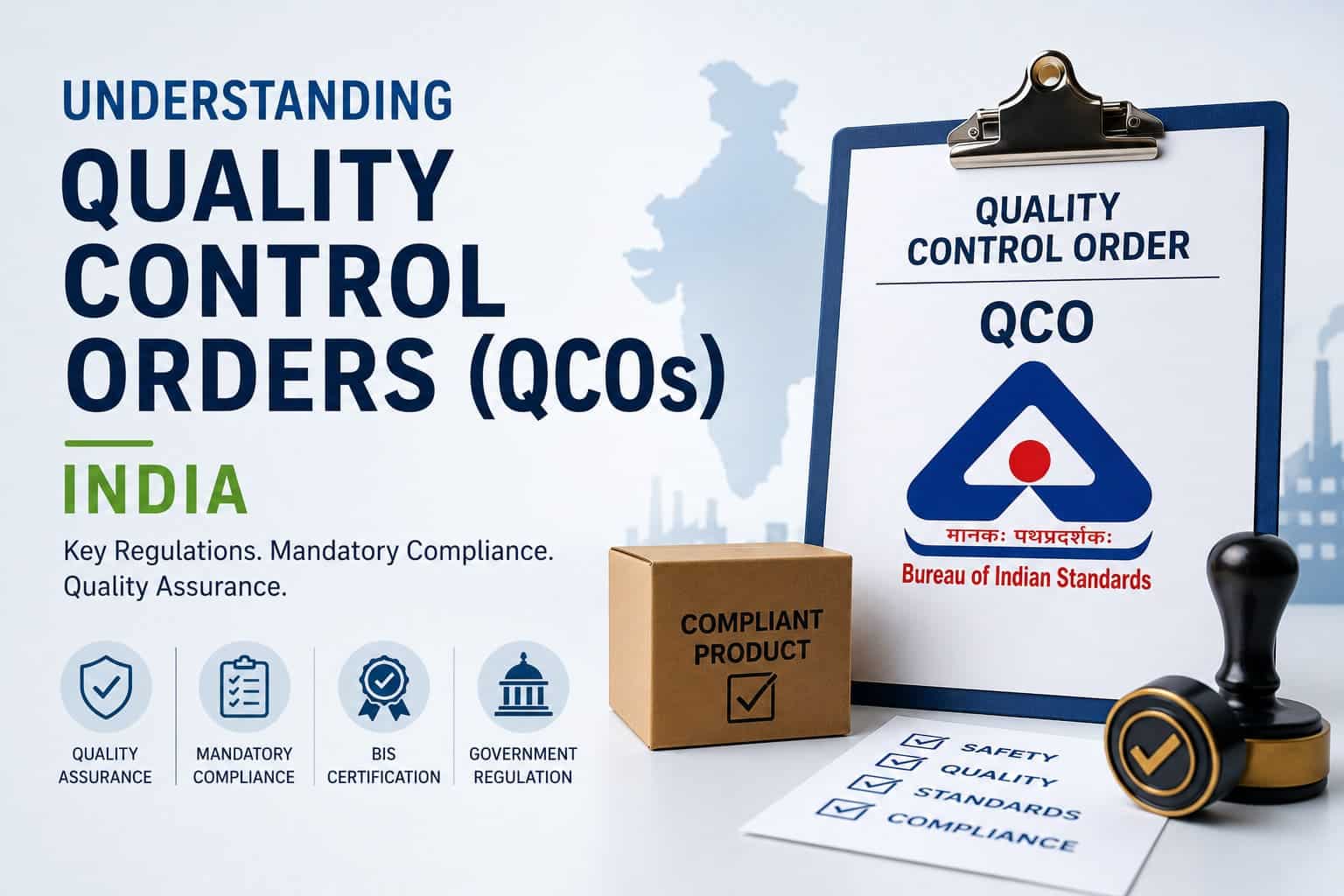
Quality Control Orders (QCOs) have become one of the most important regulatory mechanisms governing manufacturing, imports, product safety, and conformity assessment in India.
Over the last several years, the Government of India has significantly expanded the number of products brought under mandatory compliance requirements through various Quality Control Orders issued by different ministries and departments.
For manufacturers, importers, distributors, brand owners, and foreign suppliers, understanding QCOs is no longer optional. Non-compliance can lead to shipment detention, customs clearance issues, market restrictions, penalties, cancellation of licenses, and legal consequences.
At the same time, QCOs have also created a more structured compliance ecosystem aimed at improving product quality, consumer safety, standardization, and manufacturing reliability across industries.
This guide explains how QCOs work in India, how they relate to BIS certification, which industries are commonly affected, and what businesses should understand before manufacturing or importing regulated products.
What Are Quality Control Orders (QCOs)?
Quality Control Orders (QCOs) are legal notifications issued by the Government of India making compliance with specific Indian Standards mandatory for certain products.
These orders are generally issued by ministries or regulatory departments under relevant legislative powers and typically require products to conform to prescribed Indian Standards before they can be manufactured, sold, imported, distributed, or stored in India.
In most cases, QCOs mandate certification through the Bureau of Indian Standards (BIS).
Once a product falls under a QCO, compliance becomes compulsory rather than voluntary.
This means manufacturers and importers cannot legally place non-compliant products into the Indian market after the effective implementation date of the order.
Why Are QCOs Important?
QCOs play a major role in:
- Improving product quality
- Protecting consumer safety
- Reducing substandard imports
- Ensuring manufacturing consistency
- Promoting standardization
- Supporting fair competition
- Strengthening quality infrastructure
From a regulatory perspective, QCOs help create minimum quality benchmarks across industries.
From a market perspective, they encourage manufacturers to adopt structured quality systems and standardized manufacturing practices.
Increasing Importance of Compliance in India
India has witnessed rapid growth in various such as:
- Manufacturing
- Infrastructure
- Electronics
- Industrial equipment
- Consumer goods
- Imports
As product complexity and market scale increase, regulatory oversight has also become more stringent.
QCOs are now commonly seen across:
- Steel products
- Chemicals
- Electronics
- Footwear
- Machinery
- Household appliances
- Construction materials
- Automotive components
- Industrial products
- Consumer goods
Businesses operating in India must therefore integrate regulatory compliance into their operational strategy rather than treating it as an afterthought.
Legal Basis of QCOs in India
Quality Control Orders are generally issued under provisions of:
- The Bureau of Indian Standards Act 2016
- Sector-specific regulatory frameworks
- Government notification powers through Gazzette
Different ministries may issue QCOs depending on the product category and industry sector which are in their ministerial control.
The orders usually specify:
- Applicable Indian Standard
- Product scope and varieties covered
- Timelines for implementation
- Certification requirements
- Marking obligations
- Exemptions, if applicable
Once notified and enforced, compliance becomes legally mandatory. Such QCO notified products requires BIS Certification in order to manufacture, sell or import to India.
Role of BIS in QCO Compliance
The Bureau of Indian Standards (BIS) serves as the national standards body of India and plays a central role in implementation of many QCOs.
The role of BIS include:
- Formulation of Indian Standards
- Grant of licenses under various Conformity Assessment Schemes
- Hallmarking of precious Jewelleries
- Surveillance activities such as factory inspections and Market surveillance
- Testing oversight
When a QCO mandates BIS certification, manufacturers must generally obtain certification under the applicable BIS scheme before selling products in India.
How QCOs Work
The compliance process generally follows a structured framework.
Step 1: Government Identifies Product Category
The concerned ministry identifies products where mandatory quality regulation is considered necessary.
This may be based on:
- Safety concerns
- Consumer protection
- Substandard imports
- Industry quality issues
- Environmental concerns
- Strategic industrial priorities
Step 2: Applicable Indian Standard Is Specified
The QCO identifies:
- Relevant Indian Standard (IS)
- Technical scope
- Conformity requirements
Products covered under the order must comply with that standard.
Step 3: Implementation Timeline Is Announced
The notification generally includes:
- date of publication
- implementation date
- transition timelines
- applicability conditions
Manufacturers are expected to obtain compliance before the effective date.
Step 4: BIS Certification Becomes Mandatory
Where BIS certification is required, manufacturers must:
- apply for certification
- complete testing
- undergo inspection if applicable
- obtain license or registration
- use prescribed standard marking
Step 5: Regulatory Enforcement (Implementation of Quality Control Orders) Begin
After implementation of QCOs:
- Non-compliant products may be restricted
- Imports may be stopped
- Customs may require compliance proof
- Enforcement agencies may initiate action
Products Covered Under QCOs
The number of regulated products under QCOs has expanded substantially over recent years. Currently, over 600 products are under mandatory certification through QCOs under the ISI Marking Scheme alone.
Common sectors include:
Steel and Metal Products
Examples include:
- Steel plates
- Pipes
- Structural steel
- Stainless steel products
- Reinforcement bars
- Fasteners
These products are often regulated due to:
- Structural safety concerns
- Infrastructure quality requirements
- Industrial reliability
Electronics and IT Products
Many electronics products are covered under:
- CRS registration
- Electronics-related QCOs
Examples include:
- LED lighting products
- Adapters
- Power banks
- Televisions
- IT equipment
- Audio/video devices
Chemicals and Industrial Materials
Several industrial chemicals and raw materials are regulated to ensure:
- safety
- consistency
- environmental compliance
Footwear Products
Footwear-related QCOs have expanded significantly in India.
These may cover:
- safety footwear
- rubber footwear
- leather footwear
- protective footwear categories
Household and Consumer Products
Examples may include:
- kitchen appliances
- pressure cookers
- electrical accessories
- toys
- domestic equipment
These are often regulated because of direct consumer exposure.
Machinery and Industrial Equipment
Industrial equipment categories may also fall under mandatory certification frameworks.
Examples include:
- pumps
- compressors
- valves
- welding equipment
- industrial machinery components
Ministries Commonly Issuing QCOs
Various ministries and departments may issue QCO notifications depending on product category.
These may include ministries associated with:
- industry
- commerce
- heavy industries
- electronics
- chemicals
- steel
- textiles
- consumer affairs
Manufacturers should carefully track notifications relevant to their sector.
Mandatory vs Voluntary BIS Certification
One of the most common areas of confusion involves understanding the difference between voluntary certification and mandatory certification under QCOs.
Voluntary Certification
In voluntary certification:
- manufacturers choose to obtain certification
- certification is optional
- products may still be sold without BIS mark unless separately regulated
Businesses may voluntarily obtain certification for:
- market credibility
- customer trust
- procurement eligibility
- quality positioning
Mandatory Certification Under QCOs
Under QCOs:
- certification becomes legally compulsory
- products cannot be legally sold without compliance
- imports may be restricted without certification
This significantly changes the regulatory obligations of businesses.
How to Check Whether Your Product Falls Under a QCO
Determining applicability is one of the most important compliance steps.
Manufacturers should evaluate:
- product description
- HS codes
- Indian Standard references
- product specifications
- intended usage
- ministry notifications
Small technical differences can sometimes determine whether a product is covered.
Importance of Correct Product Classification
Incorrect classification may result in:
- delayed imports
- customs issues
- regulatory violations
- certification rejection
- unnecessary testing
Many businesses underestimate the importance of technical classification during the early stages.
Reviewing the Applicable Standard Carefully
Manufacturers should carefully review:
- product scope
- exclusions
- definitions
- technical applicability
- referenced clauses
Some products may appear similar commercially but fall outside the technical scope of a specific standard.
Impact of QCOs on Manufacturers
QCOs directly affect manufacturing operations.
Manufacturers may need to:
- upgrade processes
- improve testing systems
- implement quality controls
- maintain documentation
- establish traceability
- improve production consistency
Compliance may require operational investment, especially for businesses transitioning from unregulated environments.
Shift Toward Structured Quality Systems
One major effect of QCO implementation is the gradual shift toward:
- standardized production
- documented quality systems
- controlled manufacturing environments
- traceable operations
This often improves long-term manufacturing reliability.
Increased Focus on Testing Infrastructure
Manufacturers may need:
- internal testing capability
- calibrated equipment
- trained quality personnel
- documented inspection procedures
Testing readiness becomes an essential operational requirement rather than an optional activity.
Impact on Importers
Importers dealing with regulated products must ensure imported goods comply with applicable BIS requirements before products enter the Indian market.
This is particularly important because customs authorities may require:
- BIS license details
- registration information
- compliance declarations
- standard marking verification
Importers dealing with non-compliant goods may face:
- shipment delays
- detention
- re-export requirements
- clearance complications
- financial losses
Importer Responsibility
Many importers incorrectly assume that compliance responsibility lies entirely with the foreign manufacturer.
In reality, importers should actively verify:
- certification validity
- product scope
- model coverage
- labeling compliance
- applicable standards
Failure to perform due diligence can create significant operational risk.
Importance of Supplier Verification
Importers should carefully evaluate:
- supplier manufacturing capability
- authenticity of certifications
- consistency of product quality
- scope of approvals
- ongoing compliance status
Supplier compliance monitoring becomes especially important for long-term import operations.
Impact on Foreign Manufacturers
Foreign manufacturers supplying regulated products to India are increasingly affected by QCO implementation and BIS certification requirements.
Products covered under mandatory certification frameworks generally cannot be legally exported to India without compliance.
This has made Indian regulatory approval an important consideration for global manufacturers seeking access to the Indian market.
Need for Regulatory Preparation
Foreign manufacturers often underestimate:
- Indian conformity requirements
- documentation expectations
- testing obligations
- factory inspection readiness
- marking requirements
Early planning significantly improves the certification process.
Authorized Indian Representative (AIR)
Under certain schemes such as FMCS and CRS, foreign manufacturers may need to appoint an Authorized Indian Representative (AIR).
The AIR acts as the official local representative for regulatory coordination and compliance communication within India.
The AIR may assist with:
- application coordination
- regulatory communication
- document handling
- compliance support
Common Industries Affected by QCOs
QCO implementation has expanded across multiple industrial sectors.
Industries commonly affected include:
- steel manufacturing
- electronics
- electrical equipment
- chemicals
- polymers
- consumer goods
- footwear
- automotive components
- construction materials
- industrial machinery
As India expands domestic manufacturing initiatives, additional sectors may continue to come under regulatory control.
Product Testing Under QCOs
Testing is one of the most critical elements of QCO compliance.
Products must generally demonstrate conformity with the applicable Indian Standard through testing conducted at:
- BIS laboratories
or - BIS-recognized laboratories
Purpose of Product Testing
Testing helps verify:
- product safety
- technical performance
- durability
- material characteristics
- compliance with prescribed requirements
Testing requirements vary significantly depending on:
- product category
- risk profile
- applicable standard
- certification scheme
Importance of Representative Samples
The submitted sample should accurately represent actual production goods.
Differences between:
- tested samples
- commercial production products
- labeling
- product construction
may create compliance issues during surveillance or inspection.
Common Testing Challenges
Manufacturers often face issues related to:
- incomplete documentation
- failed parameters
- inconsistent raw materials
- design deficiencies
- incorrect sample selection
- improper test preparation
Careful pre-testing and internal quality checks help reduce these risks.
Factory Inspection Requirements
Many QCO-linked certification schemes involve factory inspection or audit activities.
The purpose is to verify whether the manufacturer possesses adequate capability to consistently produce compliant products.
Areas Commonly Evaluated During Inspection
Inspecting officials may evaluate:
- manufacturing infrastructure
- production processes
- testing facilities
- quality systems
- calibration controls
- process monitoring
- record maintenance
- technical competence
The inspection is intended to assess actual manufacturing capability rather than merely reviewing documents.
Internal Laboratory Evaluation
BIS may verify:
- availability of required testing equipment
- operational condition of instruments
- calibration validity
- testing procedures
- competence of laboratory personnel
Incomplete testing capability is a common area of concern during inspections.
Production and Traceability Controls
Factories may also be evaluated for:
- incoming inspection systems
- in-process quality checks
- final inspection procedures
- batch traceability
- rejection handling
- material segregation
Structured manufacturing systems generally perform better during compliance evaluation.
Labeling and Marking Requirements
Many QCO-covered products require specific:
- standard markings
- license numbers
- registration details
- labeling information
The exact marking requirements depend on:
- applicable certification scheme
- Indian Standard
- product category
Incorrect or incomplete marking may itself constitute non-compliance.
Importance of Correct Labeling
Manufacturers should ensure:
- product labels match certification scope
- model information is accurate
- standard marks are correctly displayed
- packaging complies with regulatory requirements
Improper labeling frequently causes customs and market surveillance issues.
Penalties for Non-Compliance
Non-compliance with QCO requirements can result in serious regulatory consequences.
Possible actions may include:
- product seizure
- customs detention
- prohibition on sale
- cancellation of certification
- prosecution
- financial penalties
- market withdrawal
Businesses should therefore treat compliance as a critical operational responsibility.
Commercial Consequences
Apart from regulatory penalties, non-compliance may also lead to:
- reputational damage
- distributor disputes
- shipment losses
- delayed deliveries
- customer complaints
- procurement disqualification
For industrial manufacturers, these disruptions can create major commercial impact.
Common Compliance Challenges
Many businesses struggle with QCO compliance because they underestimate the complexity of regulatory implementation.
Common challenges include:
- incorrect applicability assessment
- delayed certification planning
- poor documentation
- inadequate testing systems
- weak quality controls
- misunderstanding of standards
- incomplete factory readiness
Documentation Gaps
Documentation inconsistencies are among the most common reasons for delay.
Examples include:
- mismatched product descriptions
- outdated calibration certificates
- incomplete technical documents
- inconsistent declarations
- incorrect model references
Maintaining organized documentation systems significantly improves compliance efficiency.
Delayed Certification Planning
Some businesses begin certification only after:
- shipment preparation
- product launch planning
- import scheduling
This often creates avoidable delays because certification timelines may involve:
- testing
- inspection
- clarification rounds
- corrective actions
Early preparation is strongly recommended.
Inadequate Quality Systems
Manufacturers operating without structured quality systems often face challenges during:
- inspections
- surveillance
- testing consistency
- record verification
Compliance should be integrated into normal manufacturing operations rather than treated as a temporary exercise.
Importance of Ongoing Compliance
Obtaining certification is not the end of the compliance process.
Manufacturers must continue maintaining:
- production consistency
- testing controls
- calibration systems
- quality procedures
- traceability mechanisms
Ongoing compliance is essential for:
- license continuity
- surveillance readiness
- market access
- long-term operational stability
Future of QCOs in India
India is expected to continue expanding mandatory quality regulation across additional sectors.
This aligns with broader national priorities related to:
- manufacturing quality
- product safety
- consumer protection
- import regulation
- industrial competitiveness
Businesses should therefore expect:
- increasing compliance requirements
- broader product coverage
- stronger enforcement
- greater technical scrutiny
Companies adopting proactive compliance systems will likely be better positioned for long-term growth.
Frequently Asked Questions (FAQs)
Let’s now take a look at some of the common FAQs you may be having about Quality Control Orders (QCOs) in India.
Are QCOs mandatory?
Yes. Once implemented, compliance with applicable QCO requirements becomes legally mandatory for covered products.
Is BIS certification always required under QCOs?
In many cases, yes. However, the applicable certification mechanism depends on the specific product category and regulatory framework.
Can imported products be sold without BIS certification if covered under a QCO?
Generally no. Covered products typically require applicable compliance before being imported or sold in India.
How can I check whether my product falls under a QCO?
Businesses should review:
- ministry notifications
- Indian Standards
- product scope definitions
- technical applicability
Professional technical evaluation may sometimes be necessary.
Do all products require factory inspection?
No. Inspection requirements depend on:
- certification scheme
- product category
- applicable standard
Some schemes involve registration-based compliance while others involve full factory assessment.
What happens if a product fails testing?
The manufacturer may need to:
- modify the product
- improve materials
- implement corrective actions
- retest the product
Repeated failures can increase both costs and timelines.
Can one certification cover multiple product variants?
In some cases, yes. Applicability depends on:
- product grouping rules
- technical similarity
- certification scheme requirements
Related Guides
You can internally link this page later to supporting resources such as:
- BIS Certification Guide
- FMCS Certification Guide
- CRS Registration Guide
- BIS Factory Inspection Process
- Documents Required for BIS Certification
- Product Testing Process Under BIS
- BIS Certification Timeline
- Mandatory Products Under BIS
- How to Check Applicable Indian Standards
- Common BIS Compliance Mistakes
Final Thoughts
Quality Control Orders have fundamentally changed the compliance landscape in India.
For manufacturers, importers, and foreign suppliers, understanding QCO requirements is now essential for lawful market access and sustainable business operations.
While compliance obligations may appear complex initially, businesses that establish:
- structured documentation
- quality systems
- testing controls
- regulatory planning
are generally better positioned to navigate the certification process successfully.
As India continues strengthening its quality ecosystem, businesses that prioritize compliance readiness will likely gain long-term operational and commercial advantages.